
Books> Statistics for beginners
The transition from any normal curve to a standard curve
In reality, we have an infinite number of possible bells, not just the standard bell. Each distribution has its own mean and standard deviation, and therefore its own bell. Our ability to calculate probabilities in a standard normal distribution does not help us (yet) in calculating probabilities in other bells, which are most cases in reality. And again, mathematicians came to our aid. They found a way to transform any normal distribution (the target curve) into a standard normal distribution . This method is called normalization . Normalization is actually a kind of “translation” of the values of any normal distribution into values that correspond to the standard bell (= standardized values ), and then we can use a table. Hence, almost any problem we want to solve will involve two separate operations:
- Regulation
- Search the table.
The standardized values are called standard scores . The standardization operation is the operation of translating from the target curve to the standard curve.
The act of standardization – preliminary pictorial illustration
Figuratively, the operation of standardization can be likened to a situation where we want to measure the length of a curled string. First, we place it on a ruler and then straighten it. This is done with some normal curve (the target curve). First, we “place” it on the standard curve (so that the center of the target curve falls on 0) and then we “shape” it exactly to the shape of the standard curve (parallel to the action of stretching the string). The shaping is possible, since both have the same area (=1).
The “presumption” and “design” are carried out using 2 simple arithmetic operations: (1) subtraction and (2) division, which are performed simultaneously .
The ” assignment” is performed by subtracting each value in the target curve (= number on the X-axis) from its expectation. Thus, its expectation becomes 0 (= expectation minus expectation). The ” design ” is done by dividing the result obtained by the standard deviation of the target curve. At the end of the process, next to each value in the target curve (we will call it: the original value ) there is another value called the standardized value .
Using the standardized values, we calculate probabilities that relate to the original values in the target curve.
And now for examples:
The normal curve in Figure A shows the height distribution of twelfth grade children; its mean is 170 cm. [170] Standard deviation – 10 [δ=10] Of course, this normal curve is not a standard curve (where the mean is equal to 0 and the standard deviation is equal to 1).
Let’s assume we want to calculate the probability of randomly meeting a child whose height is below 180 cm, or in other words, what percentage of 12th grade students are shorter than 180 cm.
To find the standard score (the standardized value) of 180, we subtract the distribution’s mean (=170) from 180, and divide the result by its standard deviation (=10) and get – 1: `[(180-170)/10-=10/10-=1]` That is, the standard score of 180 is 1.
In other words: the value 180 on the target curve is the same as the value 1 on the standard curve.
We will record the standard score (1) below the original value (180) in the chart.
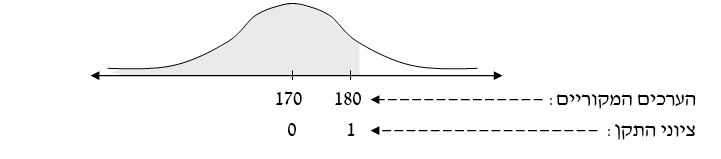
Note: The standard deviation of the span is always 0. This can be checked by nesting the span: `(170-170)/10=0/10=0`
Now instead of asking the question: What percentage of people are under 180, we can ask what percentage of the standard bell is under 1. What we have actually done: We have translated the question from one that we do not know the answer to, to one that we do know the answer to. The second question is answered using the table, and it appears that the area marked in the diagram is 0.8413, meaning that 84.13% of people are shorter than 180 cm.
In fact, the “translation” of the target curve to the standard curve involves 2 steps:
- “Stretching” or “contracting” the target curve (whose areas we want to measure) into the form of a standard normal curve (without changing the numbers on the axis. The change is only in the intervals between the numbers). The “stretching” or “contracting” is performed by the division operation in the standardization formula.
- Shifting the curve so that it rises exactly above the standard normal curve in full overlap. The shift is performed by the subtraction operation in the standardization formula.