
The Loan Market – A Detailed Overview of the Loan Market
The uniqueness of the lending market
In all markets, when we are interested in a product, we buy it. In the lending market, there are no buyers and no sellers. There are borrowers and lenders. If you have a shortage of money, you can borrow money. If you have a surplus of money, you can lend money. The amount of money that passes from the lender to the borrower is called “principal.” In return for the loan, the lender charges the borrower interest. Interest is the payment for the use of money. Usually, when interest rates fall to 0%, people will want to borrow a lot of money. When interest rates climb to the sky, people will want to borrow a little. In fact, the loan market is similar to the apartment rental market.
remark
The word interest occasionally causes confusion as it is used as an abbreviation for two terms:
- The interest rate.
- The amount of interest.
The interest rate – specifies the percentage of the principal that must be paid for the use of the money. The interest amount – specifies the monetary amount that must be paid for the use of the money. In this article, the word interest refers to the interest rate and we will be careful to use the full term interest rate .
The demand and supply curves for loans
The axes of the curve:
X-axis – Loan amounts (in NIS)
Y-axis – Interest rate (%)
[mks_col]
[mks_one_half]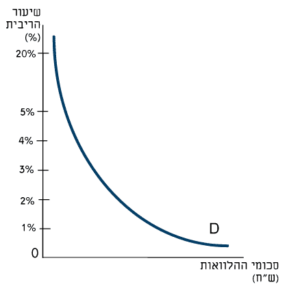 [/mks_one_half]
[mks_one_half]
The demand curve
The demand curve summarizes the public’s willingness to borrow money, depending on the interest rate. The higher the interest rate, the less they will want to borrow. Curve symbol: D Curve path: Descends from left to right.
[/mks_one_half]
[/mks_col]
[mks_col]
[mks_one_half]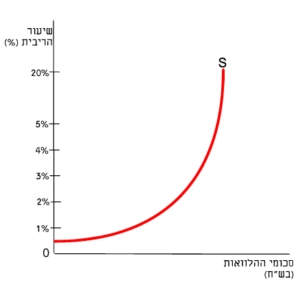 [/mks_one_half]
[mks_one_half]
The supply curve
The supply curve summarizes the public’s willingness to lend money, depending on the interest rate. The higher the interest rate, the more they will want to lend. Curve symbol: S Curve path: Rising from left to right.
[/mks_one_half]
[/mks_col]
We will expand on the logic behind the route of the demand and supply curves later.
Equilibrium point
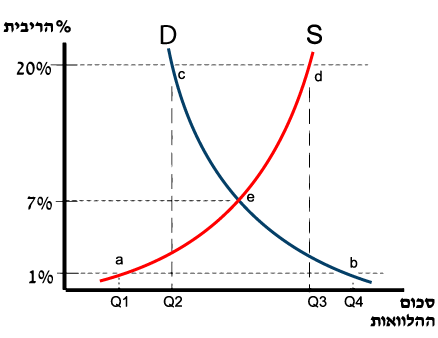
The point where the demand and supply curves meet is the equilibrium point. Only at the interest rate set at this point does demand equal supply.
The situation above or below the equilibrium point
Scenario 1
When the interest rate is lower than the equilibrium point, for example 1%, the public is interested in receiving loans (= demand for loans) in the amount of 4Q (point b) and at the same time is interested in granting loans (= supply of loans) only in the amount of 1 Q (point a), that is, demand is greater than supply by an amount of (Q4-Q1).
When the interest rate is higher than the equilibrium point, for example 20%, the public is interested in granting loans in the amount of Q3 (point d) and at the same time is interested in receiving loans only in the amount of Q2 (point c), meaning that supply is greater than demand by an amount of (Q3-Q2).
The public is the source of both demand and supply.
Note: The term public includes:
- Private individuals, known as: households.
- Various companies and corporations, known as: firms.
At any given time, some members of the public need loans while others want to lend their money to others. There are many cases where an individual (a household) or a firm is simultaneously both a borrower and a lender. For example, people who have a savings plan at a bank (i.e., they are in the position of a money lender) and, on the other hand, they have also received a loan to purchase an apartment or a car.
The effect of interest rates on the demand for loans
Low interest rate
When interest rates fall to, for example, 1%, the desire to receive loans increases among both households and firms. Among households, the desire to take out loans to purchase products increases, especially for the purchase of expensive products such as houses and cars, the main source of financing for their purchase being loans. Among firms, the desire to take out loans to expand and develop the business (purchase of equipment, machinery and buildings) increases. For many firms, loans are an important source of financing for business expansion.
High interest rate
When interest rates rise, households reduce the amount of loans intended for purchasing products, especially expensive products, and at the same time, firms reduce the total amount of loans intended for business expansion.
The effect of interest rates on loan supply
High interest rate
When interest rates are high, most households reduce the amount of money intended for consumption, especially purchases of expensive products such as apartments and cars, and divert it to providing loans for which they receive high interest. In other words: money is diverted from buying products, to providing loans. ( = increasing the supply of loans) At the same time, firms also prefer to reduce investments and divert the money to providing loans that yield them high interest. (= increasing the supply of loans)
Low interest rate
When interest rates are low, the public reduces the amounts of money they allocate to loans, since the interest they receive is “small money” and they use it to buy products. For the same reasons, firms also prefer to reduce the amounts of money allocated to loans in order to expand their business.
Loan money route
The bulk of the money intended for lending comes from the general public (households + firms). In most cases, the loans are made through the intermediary of banks (and other financial institutions). In the following, wherever we mention banks, we also refer to other financial institutions.
The flow of money from the public to banks
A portion of the public that has excess money lends its money to banks in exchange for some interest. The banks lend it on to other portions of the public that need money, in exchange for a higher interest rate that gives them a profit. The gap between the interest rate that banks pay to the public and the interest rate they charge the public is called: the interest margin .
The routes through which the public lends to banks
1. Bank deposits
The general public deposits their money in banks through a variety of channels. Each deposit of money is in effect the granting of a loan. The main channels are:
- Deposit in deposits.
- Deposits in savings plans.
2. Direct loans from the public without the mediation of financial institutions
There are 2 common routes:
- Direct loan : Mostly accepted (between relatives, friends, etc.).
- Buying bonds issued by firms and the Israeli government. The entity issuing the bonds is the borrower (the recipient of the money) and the person buying the bond is the lender (the provider of the money).
For further reading: