Books> Economics for Beginners - Tests and Solutions
Test C – Question 3
Last year, the rate of increase in the consumer price index amounted to 0%. Since the index did not increase at all, the Bank of Israel decided to lower the interest rate in the economy.
- Explain what the consumer price index is, and state one method for calculating the index. State two economic effects that the price index has on the individual.
- Show and explain, using aggregate consumption and saving curves, the effect of a decrease in the interest rate on the level of consumption and the level of saving in the economy.
- Assume that, in the initial situation, the economy is in equilibrium with unemployment. Explain and demonstrate, using the Keynesian model, the effect of lowering the interest rate on the size of output, the price level, and the scope of employment.
answer:
Section A:
The Consumer Price Index is a method by which we track changes in the prices of a specific group of products selected by the Central Bureau of Statistics and known as the “basket of products.” The basket of products includes all the products and services that an average urban family consumes during the course of a month.
The Consumer Price Index is published monthly by the Central Bureau of Statistics. It is customary to refer to any index as an initial “base index,” against which we track changes in product prices in subsequent periods.
Below is a method for calculating the index:
- Let’s assume that the price of the basket of goods in January 1950 is 250 NIS.
- Let’s assume that the price of the basket of goods in February 1950 is 260 NIS.
- According to the data, we know that in February the price of the basket of goods increased by 4% relative to the price of the basket in January 1950, according to: `(260)/(250) – 1 = 0.04 = 4%`
- We will refer to the January 1950 index as the “base index”, therefore: January 1950 index = 100 points (or 100 percent).
Therefore: The index in February 1950 will be 104 points (or 104%).
The following are examples of the economic effects that the price index has on the individual:
- Let’s assume that the workers’ wages are fixed and stand at, for example, 7,000 NIS per month. If the index increases and the workers’ wages remain at 7,000 NIS, then it is now “more difficult” to purchase products at the existing wage, meaning that with the same wage of 7,000 NIS we can purchase fewer products, since the price of the products has increased. Therefore, when the consumer price index increases and the wage remains unchanged, there is a damage to the “real wage.”
- If I have a savings plan linked to the consumer price index , then as the index rises, the value of my savings plan will also rise accordingly, so that I can buy with the amount of money I have in the savings plan the same amount of products that I could purchase before the index rose.
Section B:
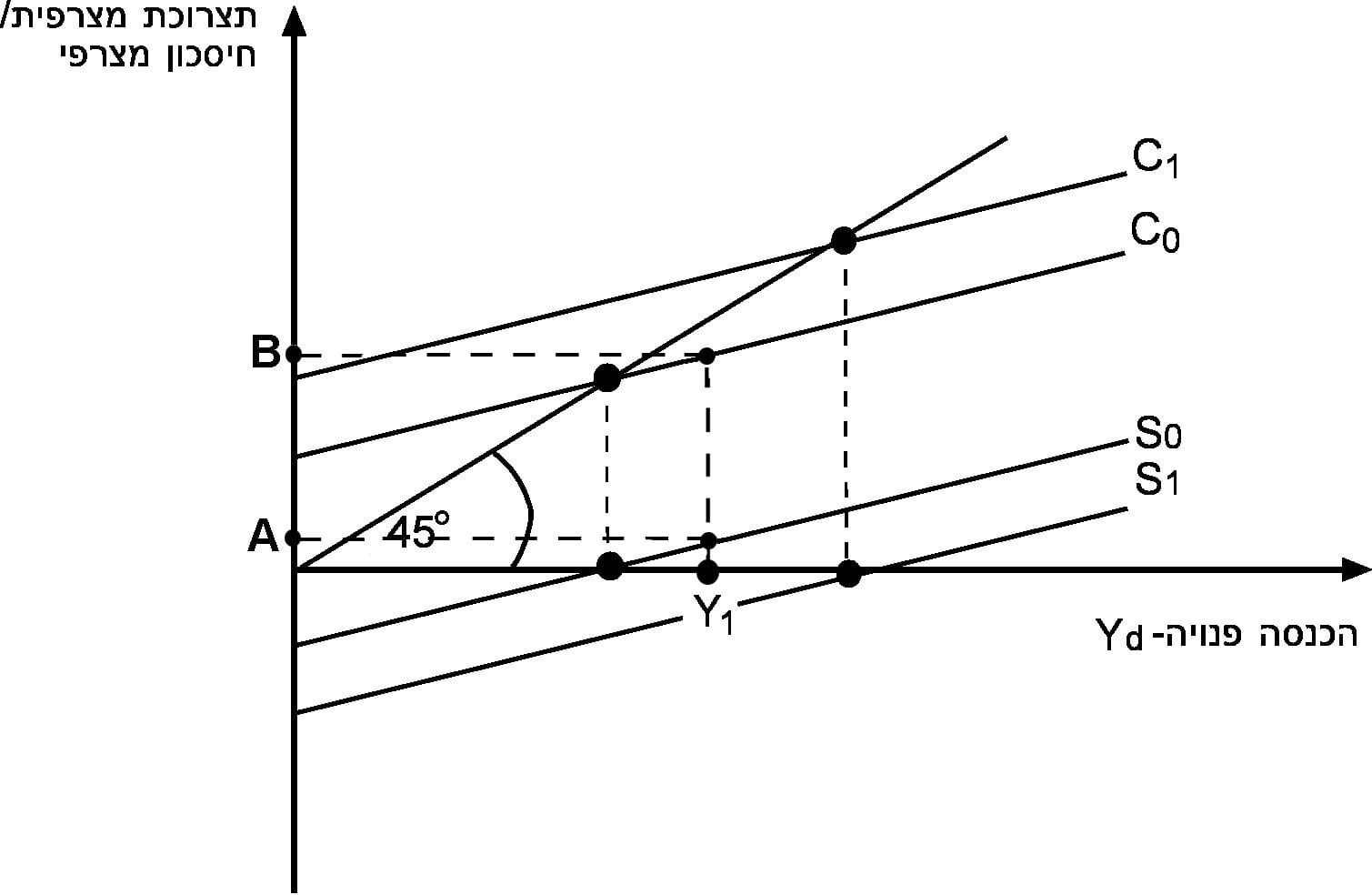
The aggregate consumption curve shows the relationship between the disposable income of all households and their planned consumption. The aggregate savings curve shows the relationship between the disposable income of all households and their planned savings.
At any level of disposable income there is: `S+C=Yd`. That is, disposable income `(Yd)` is equal to the sum of aggregate consumption `(C)` and savings `(S)`. This is expressed in the consumption and saving curves.
For example: When disposable income is `Y_1`, there is `A=Y_1` (savings) + `B` (consumption) – Figure 6.
When the interest rate in the economy falls, people will be more likely to use their disposable income for consumption rather than saving, since they will receive a lower interest rate on their savings than in the past. That is, for a given disposable income, they will allocate a larger portion of their income to consumption and a smaller portion to saving.
so:
The aggregate consumption curve will rise from `C_0` to `C_1` (for each available income, more will be consumed than before).
The aggregate savings curve will fall from `S_0` to `S_1` (for each disposable income, less will be saved than before).
In other words, a decrease in interest rates will increase aggregate consumption in the economy and decrease aggregate savings.
Figure 6:
Note: The consumption and saving curves do not always have a constant slope (a straight, upward-sloping line). For example, it is possible that the consumption curve has a decreasing slope (i.e., the curve gradually becomes vertical with increasing disposable income), while the saving curve has an increasing slope (i.e., the curve gradually becomes steeper with increasing income).
For the sake of simplicity – we solved the question with curves that are straight lines.
Section C:
In the initial state, the economy is in unemployment, meaning that output is not the maximum possible output.
GDP is equal to the sum of demand `(E)`:
`Y = E = C+G+I+XM`
(`= Y` GDP, `= C` private consumption, `= G` public consumption, `= I` investment, `X` `=` exports, `M` `=` imports)
Lowering the interest rate in itself will have an effect in the direction of GDP growth for two reasons:
- As we saw in the previous section, a decrease in interest rates increases consumption (`C` increases) and therefore increases demand and output (`Y` increases).
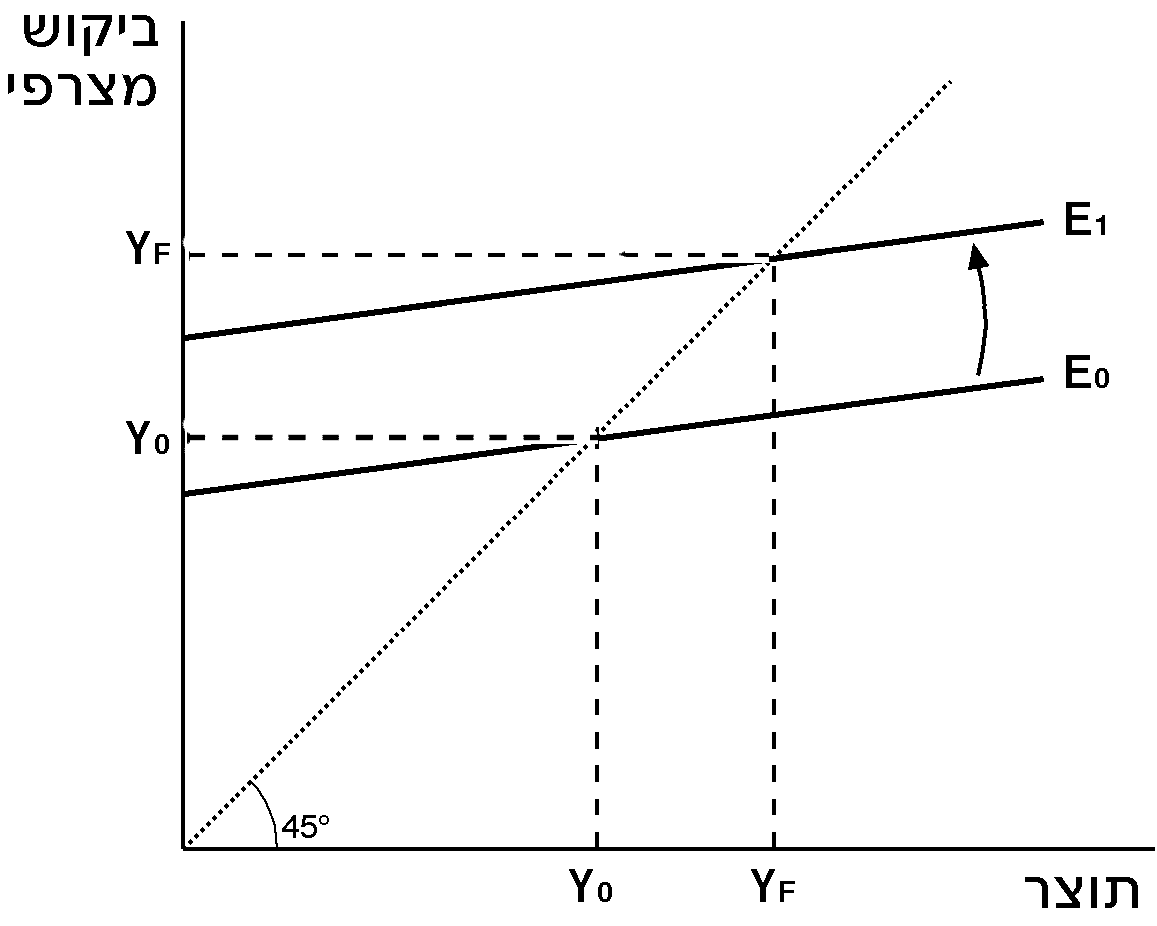
- The decrease in interest rates increases the amount of investment in the economy (`I` increases) and therefore increases demand and output (`Y` increases). Since output increases – then employment in the economy will also increase (reminder: in the initial state the economy was unemployed) because in order to produce more, more workers are needed. We will denote aggregate demand (= the sum of demands `( C+G+I+-XM =)` in the initial state by `E_0`. The output in the initial state will be denoted as `Y_0` (Figure 7).
Due to the interest rate cut, a total of 3 situations may occur:
- Aggregate demand may increase exactly to `E_1`, so that the output in the economy will be the maximum output `(Y_F)`, which is the output in a situation where all factors of production in the economy are employed. In this situation, there will be no unemployment in the economy and the price level will not change.
Figure 7:
- Aggregate demand may increase to E 2 (Figure 8), so that output will increase, but it will still be less than maximum output (output will increase to Y 1 , which is less than Y F ). In this situation, there will still be unemployment in the economy – but less unemployment compared to the initial situation, and the price level will not change.
Figure 8:

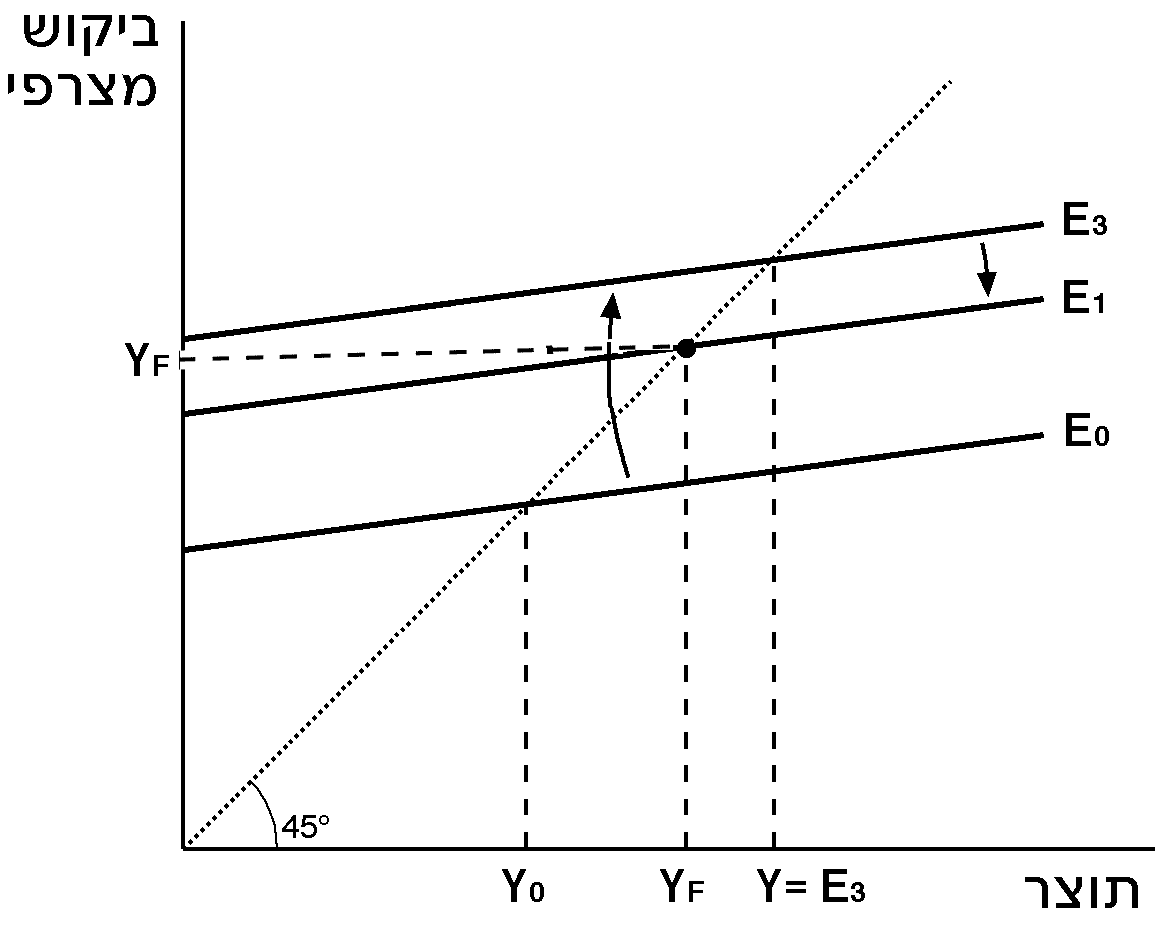
- Aggregate demand may increase above the maximum possible output, that is, it will increase to E 3 – (Figure 9). National income (product) Y = E 3 , which is not an equilibrium point. Since the real output of the economy cannot increase beyond Y F , (the points to the right of (Y F ) have no meaning). The inflationary gap will be expressed in an increase in prices. Aggregate demand will fall to E 1 so that ultimately aggregate demand will equal maximum output. In equilibrium, output will be Y F and there will be no unemployment.
Figure 9: