
For young people, renting is preferable to buying an apartment
I have often heard the following claim from young couples and their parents: When you rent an apartment, you end up with nothing left of the money, whereas when you purchase an apartment with a mortgage, you end up owning an apartment. This is, of course, a completely false claim. In this chapter, we will explain why. But at this stage, we will go ahead and say that the decision whether to purchase or rent an apartment is influenced by both financial and personal considerations. The main focus of the chapter will be on understanding and analyzing the financial considerations. After that, we will briefly review the set of personal considerations that should not be ignored.
Economic viability
For the purpose of explanation, we will use the following story: Two friends Avraham and Binyamin, who are currently living with their parents, are interested in moving into their own apartment. Avraham is interested in purchasing an apartment and Binyamin is interested in renting. At the same time, 2 identical apartments are being offered at 20 Bialik St., second floor.
One is for sale for $150,000 and the other is for rent for $500 per month.
The two friends work for the same computer company. Each of them earns $2,500 net per month ($30k per year) and has already accumulated $100,000 in savings (part of it from an inheritance). The savings are invested in a savings plan that yields 5% interest per year. This savings is called: The savings The original . We will examine below which of the friends will be richer in 12 years, in each of the 3 scenarios that we will present. In each of the scenarios, Abraham takes out a mortgage for a period of 12 years at an interest rate of 5%, repaid in 12 equal payments at the end of each year. The scenarios differ from each other mainly in the amount of the mortgage that Abraham takes out:
In scenario 1- Abraham takes out a mortgage in the amount of $150K and all of his original savings remain in the bank.
In scenario 2 – Abraham takes out a mortgage for $100k and adds $50k from his original savings.
In scenario 3 – Abraham takes out a mortgage in the amount of $50K and supplements it with $100K from his original savings.
Before we move on, let’s first explain a table called Disposal table.
An amortization schedule is a table that details how we are supposed to repay (pay off) a loan we have received. The table details the number of payments we must make, their dates, and the amount of the payment on each date. In addition, the table details how much of each payment is directed to repaying the principal and how much to paying interest. In the following example, we will present an amortization schedule in which we repay the loan in 5 equal payments.
Example:
We received a loan from the bank for $100,000, with an annual interest rate of 10%, to be repaid in 5 equal payments at the end of each year. The bank clerk calculated for us an amortization schedule for the loan, which is shown in Table 1. According to the amortization schedule, we must repay $26,380 each year (column 3).
Table 1 – Settlement Schedule (data are denominated in $)
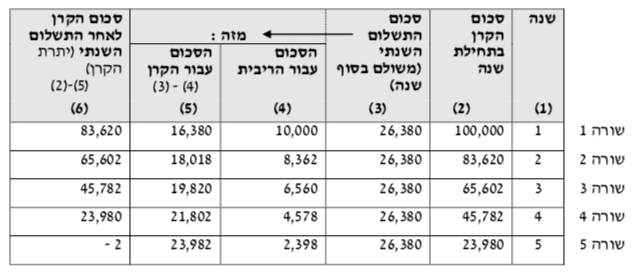
We will follow row #1 throughout all 6 columns.
Row 1 data
|
||
| Column 1- | Year . The year to which we refer | [1 ראשונה] |
| Column 2- | Fund amount at the beginning of the year | |
| Column 3- | Annual payment amount (paid at the end of the year) | |
| Column 4- | The amount for interest. The portion of the annual payment designated for interest payment (10% on the principal balance at the beginning of that year) | |
| Column 5- | The amount for the fund. The portion of the annual payment designated for fund repayment (column 3 minus column 4) | [16,380] |
| Column 6- | Principal amount after annual payment | |
An amortization schedule in which the payments are equal is called a Spitzer schedule , after its inventor. The Spitzer schedule is very popular in the mortgage industry and we will use it in our scenarios.
Commentary:
- The amounts in the table are rounded up to whole dollars. Therefore, the balance at the end of the fifth year is -2 (the bank supposedly charged us $2 more and owes us the same). If the amounts in the table were not rounded, the balance would be exactly 0. Also, in all the examples of the amortization tables below, a negligible balance will remain at the end of the period as a result of the rounding of the amounts.
- In this chapter you will not learn how the bank clerk calculated the annual repayment amount in the Spitzer table . But we will imply that he has a booklet with which he builds the amortization table.
Important features of the Spitzer table
- All payments are equal.
- The interest component of the annual payment decreases from payment to payment.
- The principal component of the annual payment increases from payment to payment.
Note: In our example, for the sake of simplicity, payments are made once a year. In reality, it is common for payments to be made once a month or quarterly.
Scenario 1 Reference to Abraham
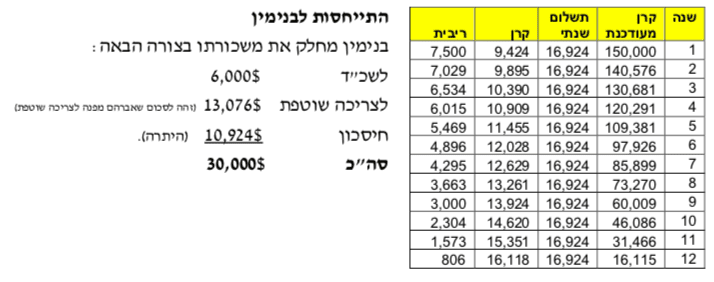
- He takes out a mortgage for $150k which he repays in 12 equal annual payments. Table 2 shows the Spitzer schedule for this mortgage. The annual repayment is $16,924.
- As mentioned, his net annual salary is $30,000 per year. In light of this His salary The available money (after paying the mortgage) is $13,076, and he decides to allocate all of it to current consumption.
Table 2 – Table Spitzer
[mks_highlight color=”#dd9933″]
For the sake of simplicity of calculations in all scenarios, let us assume that:
- The amount each member allocates to current consumption does not change from scenario to scenario and is $13,076.
- The annual savings, if any, are deposited during the year in a non-interest-bearing checking account and only starting at the end of the year are they transferred to a savings plan with a 5% interest rate.
[/mks_highlight]
A snapshot of the assets of both of them after 12 years
Table 3

Scenario 2
Reference to Abraham
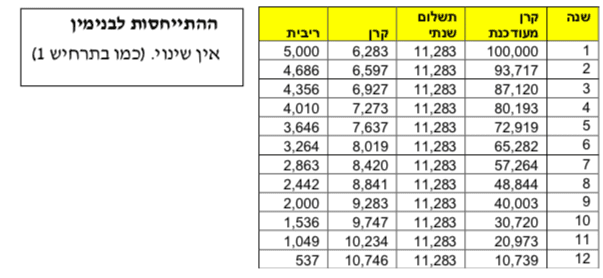
- Abraham takes out a mortgage of $100k and supplements it with $50k from his original savings . Table 4 shows the Spitzer schedule for this mortgage. The annual repayment is 11,283k.
- Abraham’s annual salary is divided as follows:
To repay a mortgage of $11,283
For current consumption $13,076
To save $5,641 (balance)
Total $ 30,000
Table 4 – Board Removal
A snapshot of the assets of both of them after 12 years
Table 5

Scenario 3
Reference to Abraham
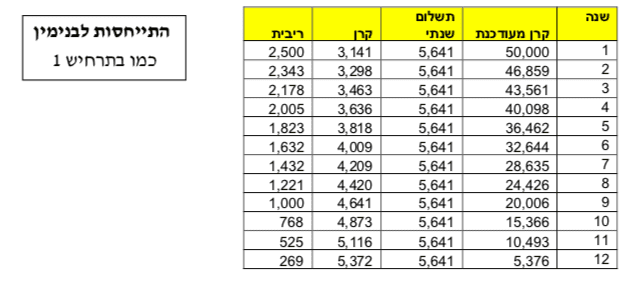
- Abraham takes out a mortgage for $50k and adds $100k from his original savings. Table 6 shows the Spitzer table for this mortgage. The annual repayment is $5,641.
- His annual salary is divided as follows:
To repay the mortgage $5,641
Current consumption $13,076
Savings $11,284
Total $ 30,000
Table 6
A snapshot of both after 12 years
Table 7
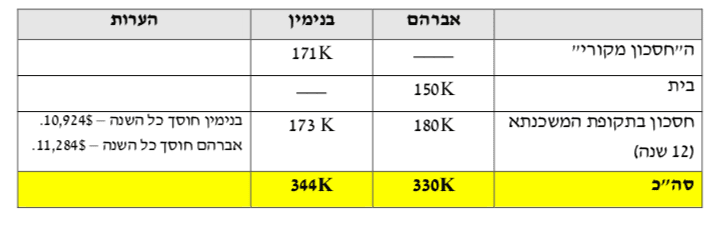
Conclusions From a look first
- The above 3 scenarios based on realistic data, which we will call: Data The market is fueling the argument that a renter loses all of their rent payments, while a buyer of a home through a mortgage ultimately owns the home. It is important to remember the saying nothing Meals Free .
- The bank grants Abraham a mortgage for which it demands full payment, expressed as interest of 5% per year (on the principal balance), just as the landlord grants Benjamin the right to use his apartment in exchange for rent of $500 per month.
- The results we obtained in the 3 scenarios are of course affected by From my data The market . If market data were to change in such a way that the rent would increase to $600 per month (instead of $500) and the interest rate on savings plans would decrease to 4% per year (instead of 5%), the results would improve in favor of the homebuyer (Abraham), as we will see immediately. For the sake of explanation, we will consider two alternatives of Data Market .
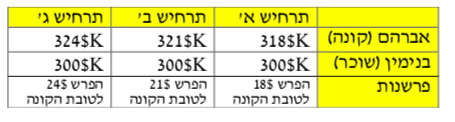
Alternative 1 – $500 rent. 5% interest. Alternative 2 – $600 rent. 4% interest.
Tables 1 and 2 present a summary of the situation of Abraham and Benjamin, after 12 years, in each of the 3 scenarios.
Where: Table 1 – refers to the market data for Alternative 1.
Table 2 – Refers to the market data for Alternative 2.
Image situation The assets of the 2 friends At the end of 12 years . In each of the 3 scenarios
Table 1 – Market data: Rent $500 per month. Interest 5%. (Alternative 1)
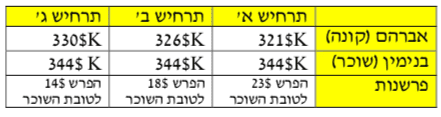
Table 2 – Market data: Rent $600 per month. Interest 4%. (Alternative 2)
If we were to consider another alternative (alternative 3) in which the market data is: $400 per month and the interest rate is 7%, the results at the end of 12 years would be in favor of the tenant.
Additional data to consider
- In all scenarios, we assumed that apartment prices would remain stable throughout the period, but in practice, based on past apartment market data, it is more accurate to assume that apartment prices would increase on average by about 2% per year in real terms, and on the other hand, wear and tear and obsolescence should be deducted from the value of the apartment at a rate of
of about 0.75% per year. So it is appropriate to add about 1.25% per year to the rent ( = $1,875). - It should be remembered that the increase of 1.25% per year is on average. There are periods when apartment prices fall, even sharply. Alongside years when apartment prices rise at sharp rates (5%). There are also areas where prices fall in a given year, even when the apartment market as a whole rises, and of course there are also opposite cases.
- Buying and selling an apartment involves financial expenses that range from 3-4% of its price.
- Current expenses that apply to the apartment owner.
- Brokerage fees. A buyer and seller of an apartment pays between 1 – 2% of the value of the apartment, while a renter pays about one month’s rent in the first year.
- A person who purchases an apartment through a mortgage is essentially investing some or all of their savings in the apartment. The buyer hopes that the value of the apartment will increase over the years and yield a higher profit than they would be able to receive through other means. However, there may certainly be alternative investments that will yield a higher profit, such as:
- Investing in education (= human capital) (of one’s own/or one’s children) Investing in human capital has proven to be extremely profitable in recent years. In the author’s opinion, over time it is far superior to investing in apartments. Human capital is the main cause of the wage gap that is widening in favor of the educated.
- Investing in listed real estate companies. Investing in them does not involve various expenses that accompany the purchase and sale of an apartment.
- Investing in plots of land. Usually, when apartment prices rise, plot prices rise more, and the opposite when apartment prices fall.
- Investing in a business.
- Investing in a savings plan.
Non-economic considerations in owning an apartment
for:
- You felt safe. You had a roof over your head.
- Interior design that suits your taste – It is usually not worthwhile for apartment tenants to invest large sums in apartment design.
against:
- The need to change apartments frequently as a result of overcrowding, a change of workplace, a changing environment, etc. Today, people change apartments on average once every 8-10 years.
- Every apartment exchange (sale + purchase) involves expenses that amount to %-6% % of its value.
And in conclusion
- The purpose of the chapter was solely to clarify that, from an economic perspective, buying an apartment is not in every case preferable to renting an apartment. There are situations where it is, and there are situations where it is not.
- For many people, purchasing a home is the most significant transaction they will make in their lives. It is advisable for them to carefully consider the effects and consequences of the purchase on their life path for a generation or two ahead.