Choosing between leisure and products – Introduction

The basket of necessities consists of two products:
- Leisure hours
- Breads
Leisure is measured in hours and breads in units.
The market data on date A are:
- Hourly wage – 20 NIS
- Price of a leisure hour – 20 NIS
- Bread price – 10 NIS
The explanation: Every hour of leisure involves giving up an hour of work worth 20 NIS.
Budget Constraint Line and Indifference Curves
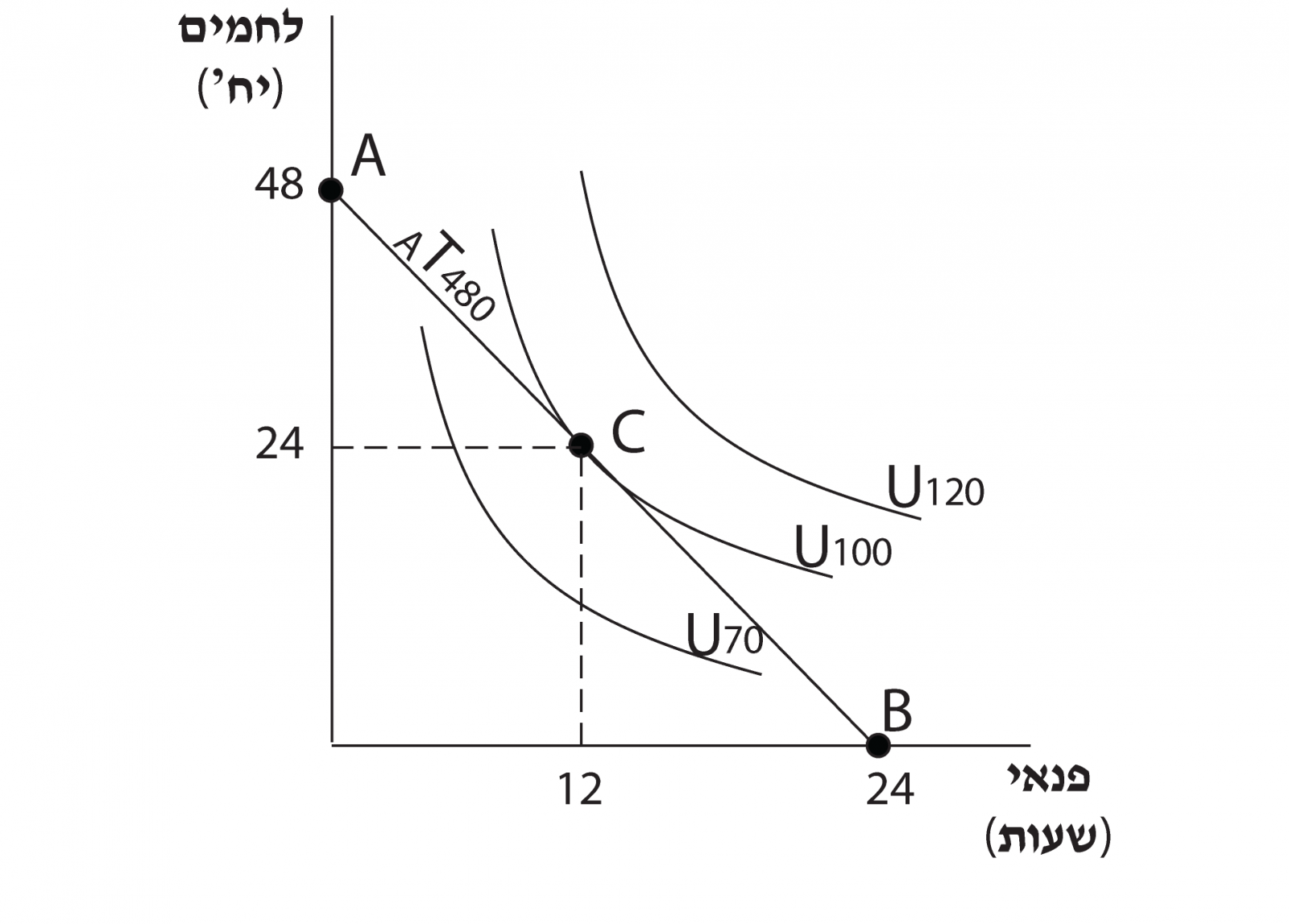
Figure 6.1 shows:
- Moses’ budget constraint line, symbolized by: A T 480 (480 indicates the value of the baskets on it, as will be explained later).
- Moses’ indifference curves to leisure and bread.
Chart axes:
- The x-axis is leisure hours.
- The y-axis is for breads (in units).
A T 480 meets the x-axis at about 24 hours leisure (point B) and the y-axis at about 48 loaves (point A).
Each super basket contains products worth 480 NIS, for example:
- Basket A contains 48 loaves of bread worth 480 NIS.
- Basket B contains 24 hours of leisure worth 480 NIS.
- Basket C contains 24 loaves of bread worth 240 NIS + 12 hours of leisure worth 240 NIS, for a total of 480 NIS.
The slope of A T 480 is , which means: For every additional hour of free time, 2 loaves of bread must be given up. On the other hand, for every additional loaf of bread, ½ hour of free time must be given up.
Figure 6.1
A consumer who has additional sources of income
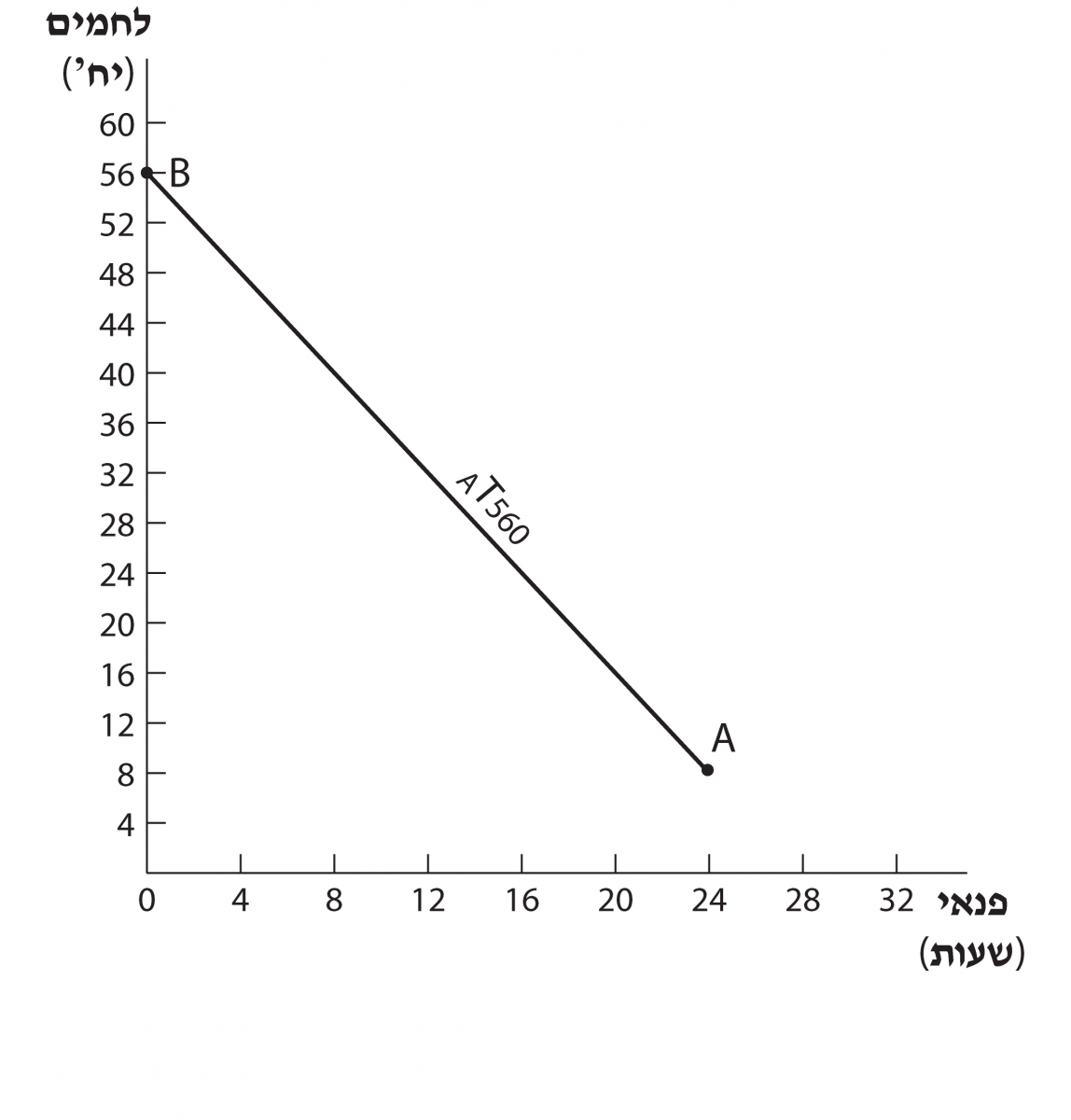
If Moshe has additional sources of income, such as: income from a rental (or interest) in the amount of 80 NIS per day, then even if he does not work at all (his leisure consumption will reach 24 hours) he will be able to purchase 8 loaves of bread (Basket A).
Figure 6.2 shows the budget constraint line relating to this scenario, symbolized by: A T 560 .
A T 560 starts at bin B on the y-axis and goes down to bin A.
Basket B contains 56 loaves of bread and 0 hours of leisure. Explanation: If Moshe does not rest for a moment, he will have 560 NIS, 480 NIS from work and 80 NIS from rent, for a total of 560 NIS with which he will purchase 56 loaves of bread.
Basket A contains 8 loaves of bread and 24 hours of leisure, which are also worth 560 NIS.
Figure 6.2